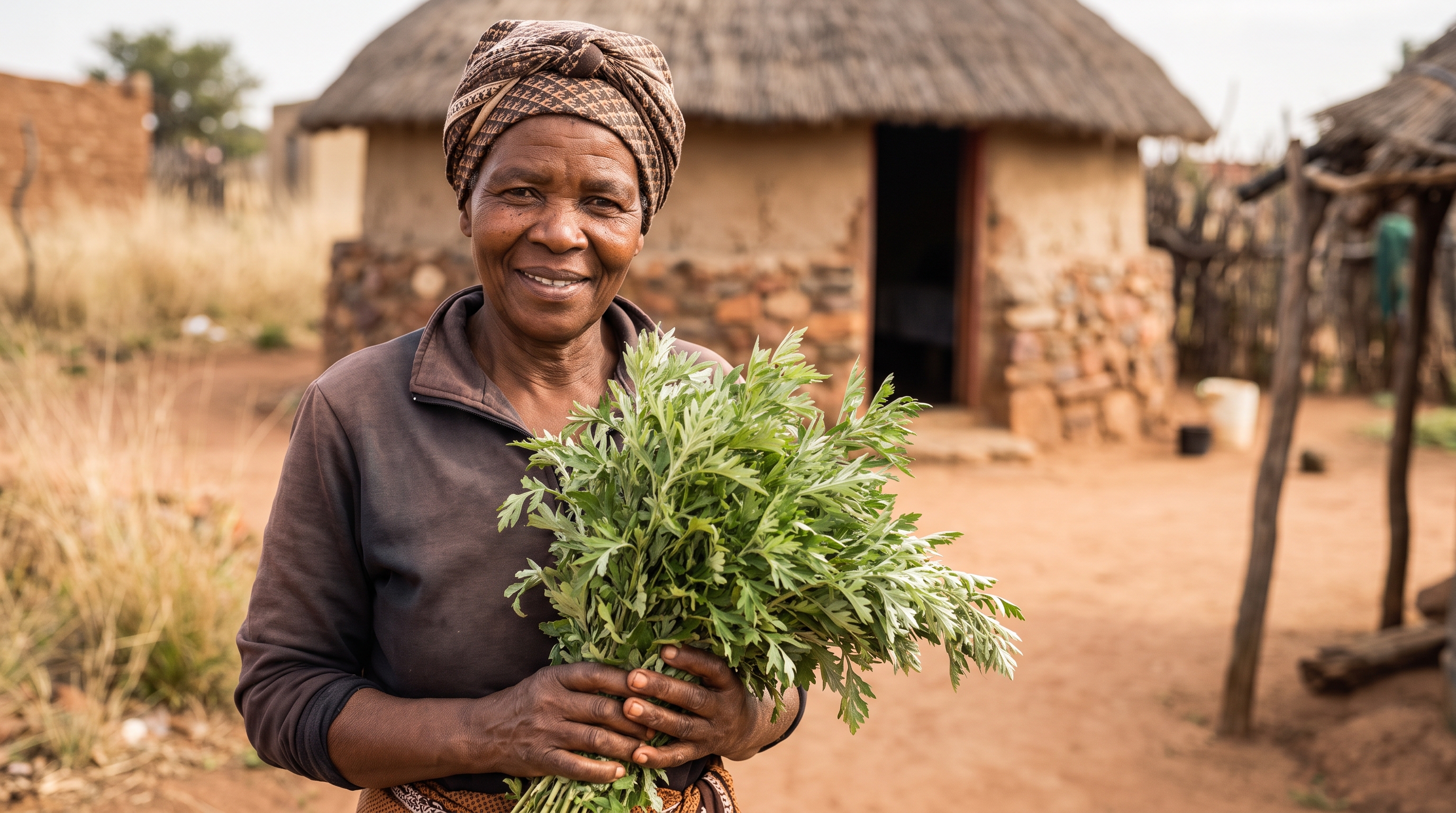
Long before the term "ethnobotany" existed, the indigenous peoples of southern Africa had already developed an extensive pharmacological relationship with a single silvery-green shrub: Artemisia afra. Known as Umhlonyane in isiXhosa and isiZulu, wilde-als in Afrikaans, and "African wormwood" in English, this member of the Asteraceae family grows wild across the grasslands, fynbos margins, and mountain slopes from the Western Cape through the Drakensberg and into tropical East Africa. The plant is woven so deeply into local healing traditions that it remains one of the most widely traded medicinal plants in the region.
What is notable for modern researchers is that the traditional uses of Artemisia afra — for fever, cough, colds, respiratory discomfort, and immune support — are now being systematically examined in peer-reviewed phytochemistry and pharmacology laboratories. The body of evidence is far from complete, but the early picture is consistent with what traditional knowledge has long suggested.
Phytochemistry: What the Plant Actually Contains
The biological activity of Artemisia afra is driven by a complex mixture of secondary metabolites, with the dominant class being the terpenoids. Essential oil analyses from plants collected across South Africa consistently identify 1,8-cineole (eucalyptol), camphor, α-pinene, α-thujone, and bornyl acetate as the major volatile constituents, although the exact chemotype varies by geography, altitude, and harvest season. In addition to the volatiles, the plant contains a wide range of non-volatile phytochemicals: sesquiterpene lactones, flavonoids (including luteolin, apigenin, and their glycosides), coumarins, and phenolic acids.
This chemical complexity matters. Unlike a single-molecule pharmaceutical, plant extracts contain dozens of constituents acting in concert, which is one reason the same plant can be reported in the literature to have anti-inflammatory, antimicrobial, antiviral, bronchodilatory, and immunomodulatory activities. A comprehensive review of the phytochemistry and biological activities of Artemisia afra is available on PubMed, and a detailed chemical characterisation is indexed in PMC.
Traditional Uses and the Ethnopharmacology Record
The ethnobotanical literature documents Artemisia afra as one of the most widely used medicinal plants in southern Africa. Recorded indications include respiratory complaints (coughs, colds, influenza, bronchial congestion), fever, headache, colic, gout, loss of appetite, and topical applications for wound care. Preparations are typically aqueous infusions or decoctions (steamed or boiled leaves), steam inhalations, and poultices.
What makes Artemisia afra unusual is the depth and continuity of this knowledge. A Journal of Ethnopharmacology review of medicinal plants used by the Khoisan and other southern African groups identifies Artemisia afra as a flagship species in the regional materia medica, and the consistency of its uses across different language groups and geographic regions is itself a signal that empirical observations have been transmitted and refined over many generations.
Immune-Supportive and Anti-Inflammatory Activity
The immune-supportive reputation of Artemisia afra is the most clinically relevant question for modern wellness applications, and the one most directly relevant to consumer products. Preclinical studies have reported anti-inflammatory activity in vitro and in animal models, with extracts modulating the production of pro-inflammatory cytokines and mediators including nitric oxide, prostaglandin E2, and tumour necrosis factor-α. Several constituents — particularly the flavonoids and sesquiterpene lactones — appear to interfere with the NF-κB signalling pathway, a central regulator of the inflammatory response.
Antimicrobial and antifungal activities have also been reported against a range of respiratory and skin pathogens, including Staphylococcus aureus, Streptococcus pneumoniae, Klebsiella pneumoniae, and Candida albicans, although the potency varies significantly between chemotypes and extraction methods. These findings are catalogued across multiple PubMed entries and form the empirical bridge between the traditional respiratory indications and contemporary interest in immune-supportive supplements.
It is important to be clear: this is research-grade evidence. In vitro and animal-model findings do not translate directly into clinical recommendations, and the responsible framing is that Artemisia afra is a promising candidate for further study rather than a proven therapy. South African health regulations prohibit medical claims for complementary medicines, and any product that contains it should be marketed for general wellness support, not for the treatment of specific conditions.
Safety, Adulteration, and Quality Considerations
Two quality issues deserve particular attention. The first is thujone content. α-Thujone and β-thujone are monoterpenes found in Artemisia afra essential oil that, in concentrated doses, are neuroactive and have been associated with adverse effects at sustained high intake. Aqueous infusions (traditional tea preparations) contain relatively low thujone levels, but concentrated tinctures and essential oils require careful dosing and quality control. The toxicology of thujone is reviewed on PMC.
The second issue is botanical authentication and adulteration. Because Artemisia afra is wild-harvested and the genus Artemisia contains several morphologically similar species, third-party verification of botanical identity is essential. Reputable suppliers should provide a certificate of analysis confirming species identity (typically by HPLC fingerprinting or DNA barcoding), heavy-metal screening, microbial limits, and quantitative marker compounds.
Artemisia afra and the Broader African Wellness Renaissance
South Africa is unusual in having a sophisticated complementary-medicine regulatory framework sitting alongside a deep traditional knowledge base. The South African Health Products Regulatory Authority (SAHPRA) maintains a register of complementary medicines, and any product containing Artemisia afra for retail sale must comply with labelling, claims, and quality requirements under the current regulatory regime. A useful entry point is the SAHPRA complementary medicines register.
At the same time, the global wellness industry is showing renewed interest in African botanicals, and Artemisia afra is increasingly being studied alongside Aspalathus linearis (rooibos), Agathosma betulina (buchu), Hoodia gordonii, and Sceletium tortuosum (kanna) as part of a wave of evidence-based South African herbal ingredients reaching international markets.
BioMuti Immunol and Related Wellness Products
Artemisia afra features as a central ingredient in BioMuti's Immunol immune-support formula, alongside Vitamin D, Zinc, Vitamin C, and Olive Leaf Extract. Immunol is formulated as a daily capsule designed for seasonal immune resilience and is manufactured to third-party-tested quality specifications with full certificate-of-analysis documentation.
For customers interested in complementary approaches, BioMuti's Broncanol offers a respiratory-supportive herbal blend, and the Chillax formula combines African botanicals with calming nutraceuticals for evening use. The full BioMuti herbal and wellness catalogue is available online, with wholesale pricing for clinics, pharmacies, and research institutions.
For related reading, see our guides on African botanicals in modern wellness, the buchu immune-support evidence base, and the cellular role of glutathione.