When loadshedding drags into its third hour, your inbox is overflowing and your training schedule has not slowed down, the herb most clinicians quietly reach for is a greyish succulent root that grows on the sea cliffs of the Arctic. Rhodiola rosea — also known as golden root or arctic root — has been used in Scandinavian and Russian folk medicine for centuries to help people cope with cold, altitude and exhaustion. In 2026 it is enjoying a surge of interest in South Africa as one of the better-evidenced adaptogens for mental fatigue and stress-related burnout.
If you have seen Rhodiola listed on a stress or "energy" supplement and wondered whether it is just another trendy adaptogen, this guide is for you. We are going to walk through what Rhodiola actually is, what the published clinical record says it does, how to dose it safely, and how it pairs with other ingredients in a stack like BioMuti Chillax.
What is Rhodiola rosea?
Rhodiola rosea is a perennial flowering plant in the Crassulaceae family that thrives in cold, mountainous regions of the Arctic, the Rockies, the Alps, and parts of central Asia. The medicinal part is the rhizome, which has a rose-like scent when freshly cut — hence the name. The root contains a characteristic group of compounds called rosavins (rosavin, rosin, rosarin) and a phenylpropanoid called salidroside, which together are used to standardise commercial extracts.
Rhodiola has been classified as an adaptogen — a term coined by Soviet toxicologist Nikolai Lazarev in 1947 to describe compounds that increase an organism's resistance to physical, chemical and biological stressors without disturbing normal physiology. The Soviet military and space programmes studied Rhodiola extensively through the 1970s for performance under extreme conditions, which is why the bulk of the early published work is in Russian.
What does the clinical evidence actually show?
The most-cited recent evidence is a 2012 systematic review of randomised controlled trials indexed on PubMed covering Rhodiola extracts in subjects with stress-related fatigue. Across the included trials, standardised SHR-5 extract at 200–400 mg daily produced significant improvements in burnout scores, attention, and self-reported quality of life compared with placebo, with effects typically emerging within the first two weeks.
A separate double-blind trial available on PMC looked at physicians working during night shifts — a population with very real fatigue burden. Participants taking 200 mg of standardised Rhodiola extract for 14 days performed significantly better on the Conners' Continuous Performance Test, a measure of sustained attention and impulsivity, compared with placebo. Subjective fatigue scores on the Samn-Perelli scale also improved.
Mechanistically, the picture is becoming clearer. Research summarised in the Journal of Ethnopharmacology suggests that the rosavins and salidroside modulate the hypothalamic-pituitary-adrenal (HPA) axis, support catecholamine turnover, and upregulate heat-shock proteins and intracellular antioxidants. The net effect at normal doses is not stimulation in the way caffeine or modafinil are stimulating — it is a normalisation of stress response.
How does Rhodiola fit into a stress-resilience stack?
Rhodiola occupies a fairly specific niche: it is best understood as a short-to-medium-term tool for the over-stressed, under-rested population. It is not a stimulant, not a nootropic in the cognitive-enhancement sense, and not a sedative. What it appears to do, on the published record, is reduce the perceived effort of mental work and shorten recovery from acute stress.
In a stack it pairs particularly well with other adaptogens and minerals that act through complementary pathways:
- Ashwagandha (Withania somnifera) — heavily researched for cortisol modulation and sleep quality, often stacked with Rhodiola for daytime stress and evening recovery.
- Holy basil (Ocimum sanctum) — supports mood and HPA-axis balance, with overlapping but distinct mechanisms.
- Magnesium glycinate — the most-used mineral cofactor in stress and sleep formulations, addressing the dietary gap many South Africans have.
- L-theanine — an amino acid from green tea that promotes alpha-wave activity without sedation.
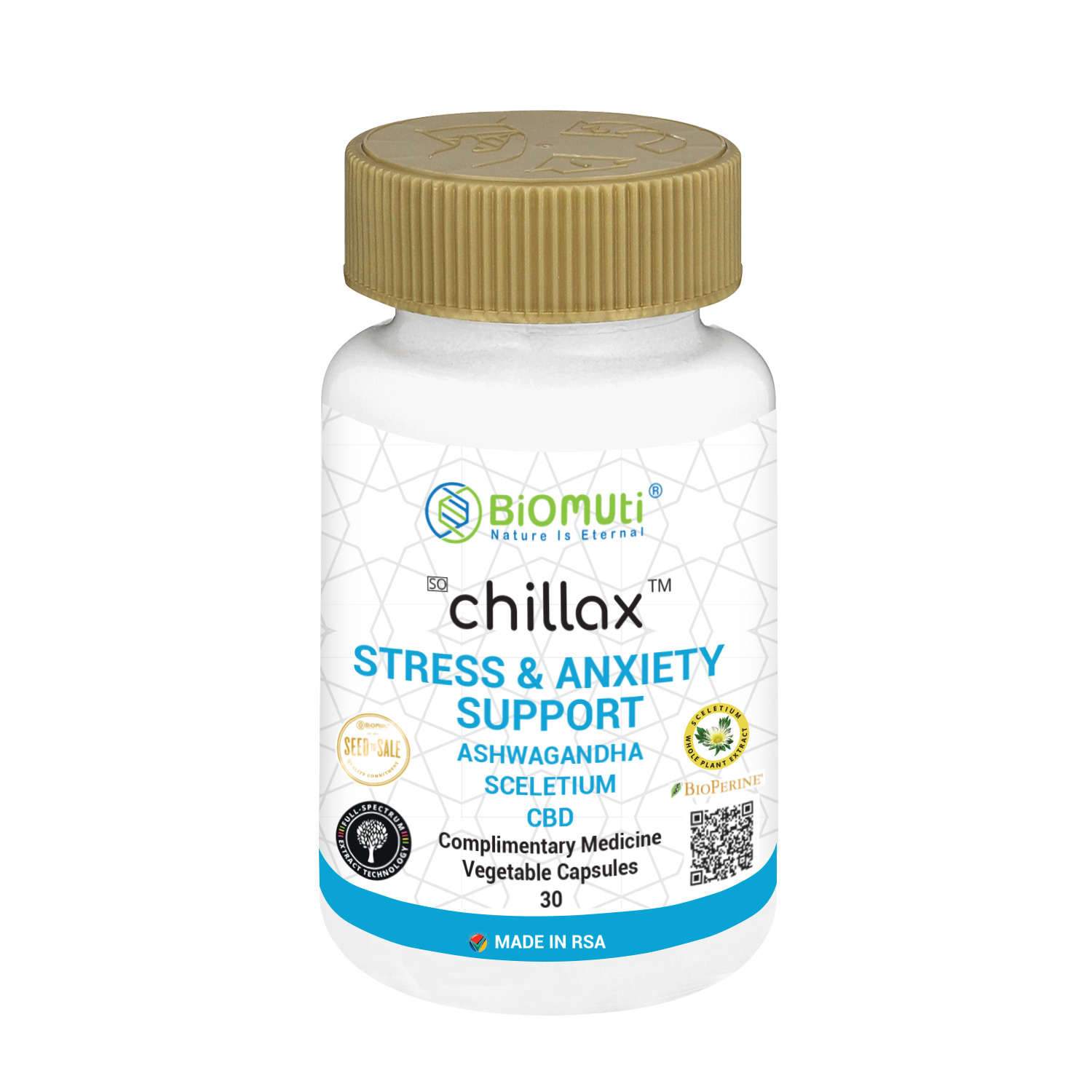
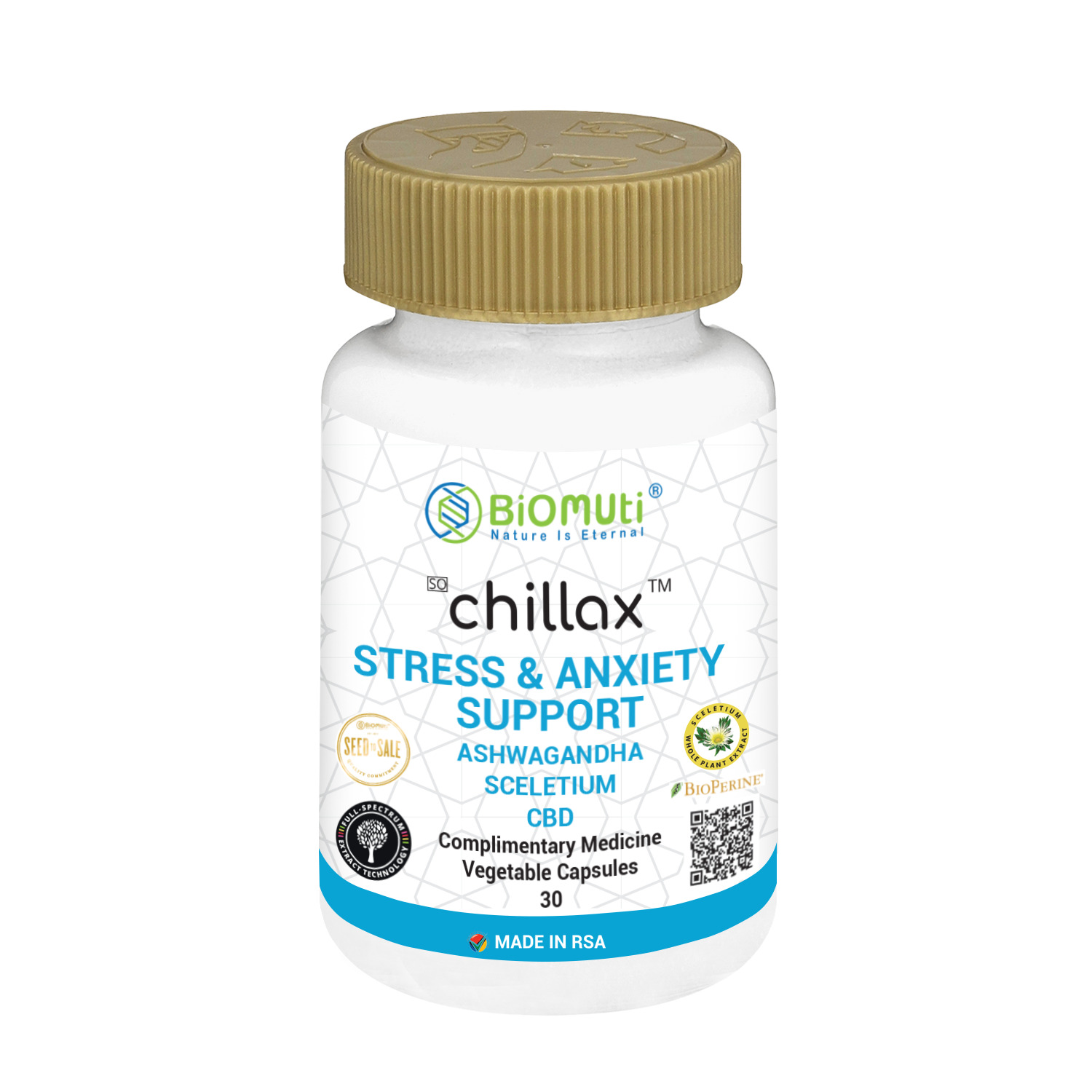
BioMuti formulates an evening adaptogen and mineral complex called Chillax, which pairs ashwagandha and magnesium glycinate with complementary calming ingredients. Rhodiola sits on the daytime side of the same family — useful in the morning or early afternoon for high-demand blocks of work, while Chillax supports the wind-down at the other end of the day.
Dosing, cycling and practical use in South Africa
Most of the published clinical work uses standardised extracts at the following doses, taken before breakfast or lunch:
- Standardised SHR-5 extract (3% rosavins, 1% salidroside): 200–400 mg per day.
- Generic 3% rosavin extract: similar milligram range, ideally split into morning and early-afternoon doses.
- Timing: taking Rhodiola late in the day can interfere with sleep onset in a small subset of users, particularly at higher doses.
Cycling is worth considering. The Soviet tradition — preserved in modern Russian-language phytotherapy literature — often used Rhodiola for two to three weeks at a time, with intermittent breaks. Several of the better-quality trials have run for 8 to 12 weeks without safety signals, but the practical risk in a high-stimulus life is dependence on feeling "on" every day, which a short cycle routine reduces.
Safety and who should be cautious
Rhodiola has a generally favourable safety record in published trials at recommended doses. Reported side-effects are mild and transient — occasional dizziness, dry mouth, or vivid dreams at the start of use. As with most adaptogens, it is not advised during pregnancy or breastfeeding, in children, or in people with bipolar spectrum presentations without professional supervision, because of its effects on catecholamine turnover.
For South Africans specifically, the practical things to check before buying are: that the label lists both rosavin and salidroside percentages (not just "root powder"), that the dose falls in the 200–400 mg standardised-extract range, and that it is sold by a supplier who publishes a certificate of analysis. Adulteration of Rhodiola with cheaper Rhodiola crenulata is a known industry issue.
The bottom line
Rhodiola rosea is one of the better-evidenced adaptogens for short-term relief of stress-related mental fatigue and burnout. The published record supports a real, measurable effect on perceived stress and sustained attention at standard doses, with a favourable safety profile over weeks to a few months of use. It is not a substitute for sleep, nutrition, or pacing — but for the weeks in life where those have genuinely slipped, it has a credible evidence base alongside other well-studied adaptogens and minerals.
Rhodiola is a reasonable option to explore when your week has tipped into consistent fatigue and your usual routines need a temporary lift. The research around adaptogens is encouraging but not yet comparable to pharmaceutical-grade evidence, and it does not justify guaranteed outcomes. Used thoughtfully alongside a daily stack like BioMuti Chillax, it can sit within a wider stress-resilience plan focused on consistency, recovery and realistic expectations.
This article is for educational purposes only and does not constitute medical advice. No claims are made regarding the treatment, cure or prevention of any disease. Speak to a registered healthcare professional before starting any new supplement, especially if you are pregnant, breastfeeding, taking medication, or managing a chronic condition.