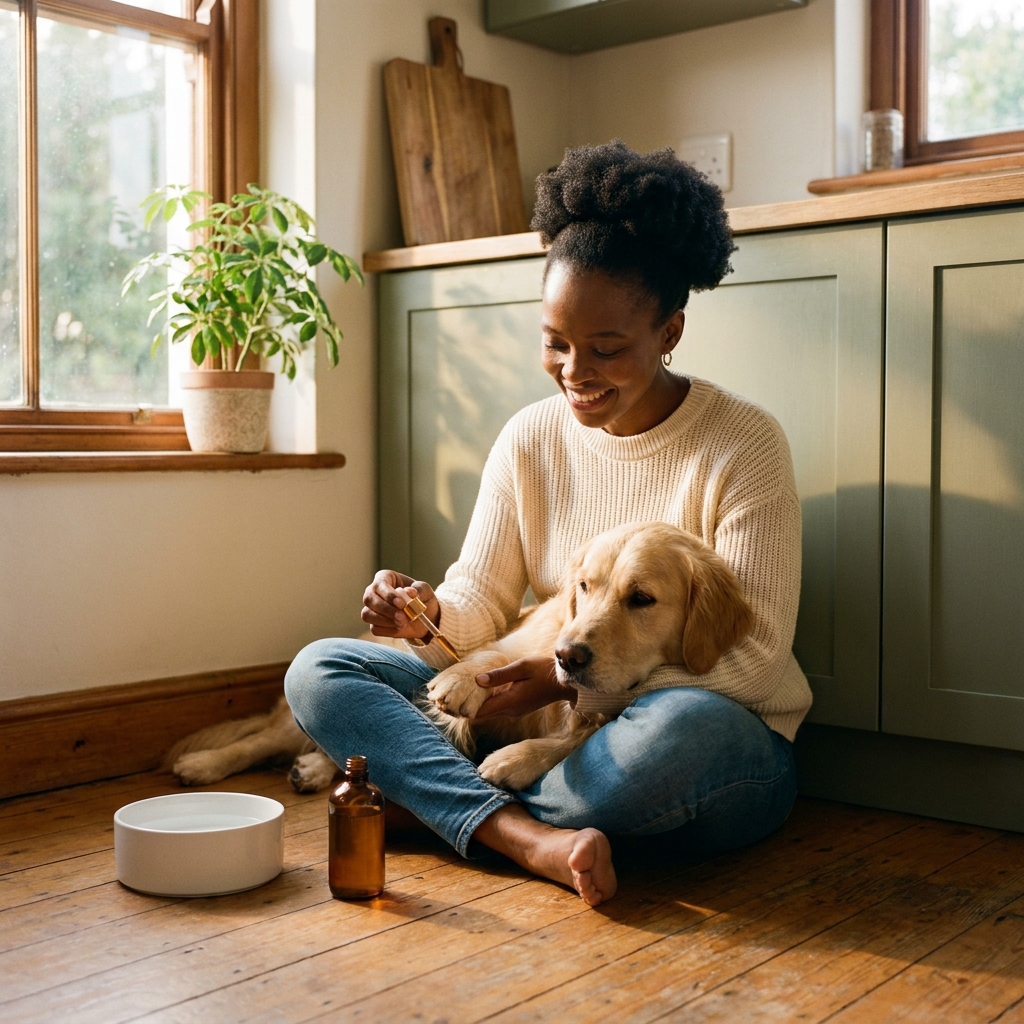
South African households share their homes with more than nine million dogs and just over two million cats, and a growing share of those pet parents are asking the same question at the vet: can CBD help my animal the way it seems to help people? The short, evidence-respecting answer is that all mammals share an endocannabinoid system, the discovery of which earned its researchers a Nobel Prize in 2024, and that CBD interacts with that system in dogs and cats in ways researchers are now actively mapping.
The endocannabinoid system your pet already has
Every mammal produces its own cannabis-like signalling molecules, called endocannabinoids, which act on CB1 and CB2 receptors distributed through the brain, immune cells, gut and peripheral nervous system. Dogs and cats have denser CB1 receptor populations in the cerebellum and brainstem than humans do, which partly explains why they are so much more sensitive to THC and why a vet-grade CBD-only product is the only safe starting point for pets.
The system is named after the plant that helped us find it, not the other way around. Researchers hunting for the receptor that THC binds to in the 1980s and 1990s discovered an entire signalling network we did not know the body carried, with two main receptors, several endogenous ligands and a fleet of enzymes that build and break those ligands down. CBD does not bind CB1 or CB2 directly the way THC does, but it influences how those receptors respond to endocannabinoids already in circulation, and it interacts with serotonin, vanilloid and adenosine targets that matter for mood, pain perception and inflammation.
What the veterinary research shows
The most cited canine study, an eight-week randomised trial at Cornell University, followed 22 dogs with osteoarthritis and found that more than 80 percent of dogs given CBD oil showed measurable improvement in pain and mobility scores, with no observable side effects. A follow-up pharmacokinetics study showed that dogs吸收 oral CBD in a predictable curve, peaking in the blood at roughly two hours and remaining detectable for six to eight hours, with the same liver enzyme (CYP3A) doing the bulk of the breakdown as in humans.
For anxiety and noise phobia, a 2023 placebo-controlled trial in Frontiers in Veterinary Science found that a single dose of CBD before a thunderstorm simulation reduced visible stress markers and lowered salivary cortisol in dogs with known storm anxiety. Cat-specific data is thinner because cats are harder to enrol in trials, but the Waltham Petcare Science Institute has shown that cats tolerate CBD similarly to dogs at conservative doses, just with a slower clearance, which is why dosing intervals for cats tend to be every 12 rather than every 8 hours.
For senior pets, a 2024 review in the Journal of the American Veterinary Medical Association concluded that CBD shows consistent, modest benefit for canine cognitive dysfunction, the dog equivalent of dementia, with improvements in night-time pacing and owner-reported sleep quality. None of this is a cure, and none of it replaces a vet visit, but the signal across more than a decade of peer-reviewed work is consistent enough that most integrative veterinarians now consider CBD a reasonable adjunct, not a fringe option.
Why BioMuti built the Animax range
Most CBD products on the South African market are bottled for humans and dosed for a 70 kg adult, which is a meaningless unit when the patient is a 4 kg Yorkshire terrier or a 40 kg Boerboel. The BioMuti Animax range was developed to remove that guesswork. Animax CBD Oil Level 1 is formulated for small dogs and cats at roughly 2 mg of CBD per millilitre, Level 2 covers medium dogs at 5 mg/ml, and Level 3 delivers 10 mg/ml for large breeds and senior pets that need higher milligram totals for comfort support. The carrier oil is organic MCT from coconut, which improves absorption and is gentle on the sensitive feline digestive tract.
Every batch comes with a third-party certificate of analysis confirming cannabinoid content, the absence of detectable THC (a hard requirement for any product labelled CBD-only in South Africa under SAHPRA scheduling), and screening for heavy metals and pesticide residues. The dropper is marked in 0.1 ml increments so dosing can be adjusted in 1 mg steps for a small cat and 5 mg steps for a large dog without maths at the breakfast bowl.
Dosing, safety and what to avoid
The current consensus dosing range across the veterinary literature is 0.2 to 0.5 mg of CBD per kilogram of body weight twice daily, starting at the low end and titrating up every five to seven days as you watch for changes in mobility, sleep and appetite. A 10 kg dog would start at 2 mg twice daily (about 0.4 ml of Animax Level 1) and a 5 kg cat at 1 mg twice daily. Effects are usually visible by week two, with the strongest mobility and senior-comfort benefits reported at the four to six week mark.
The single most important safety note is to keep CBD-only products away from any pet that might encounter THC, which is toxic to dogs at surprisingly low doses and can cause static ataxia, urinary incontinence and severe sedation that requires emergency vet care. If you are already giving your dog prescription NSAIDs, anti-seizure drugs or corticosteroids, talk to your vet before adding CBD, because the same liver enzyme handles all of them and dose adjustments may be needed. Cats are particularly prone to asymptomatic ALT elevation at higher doses, which is another reason to start low and check bloodwork annually for any senior cat on a daily CBD routine.
The bottom line for South African pet parents
CBD is not a magic fix for a stressed rescue or a creaky twelve-year-old Labrador, and no responsible company, BioMuti included, will tell you it is. What the research does support is that a clean, third-party-tested, CBD-only oil dosed by weight and titrated slowly can be a useful adjunct for canine osteoarthritis, anxiety around storms or separation, and the slower nights that come with canine cognitive decline, with a smaller but growing evidence base in cats. If you want to explore it for your pet, start the conversation with your vet, choose a product that publishes its certificate of analysis, and give it at least a month before judging the result.
The Animax CBD Oil Level 1, Level 2 and Level 3 range is available now from BioMuti with dosing guidance included for dogs, cats and the small-to-large pet spectrum that most South African households actually share their sofas with.